Unlearning how to write for an audience… so I could write for myself again
In the ecosystem of journalism and consumed media, the audience is number one. Audience determines what kind of content you make, what leads you give your attention to, how you might frame your coverage or your narrative, what is newsworthy. Ultimately it drives what makes the cut and what doesn’t. In public media especially, the audience are the people to whom the work is in service of, and thus centering their needs becomes paramount.
When I first set my eyes on the field of journalism, I came into it with this hope that sharing stories with an audience could spark change, if not at least knowledge and perspective to inform one’s own choices and outlook.
The hyper-local publications I wrote for aimed community-minded progressive audiences. At a larger public radio station on a team dedicated to community and audience engagement, I came to both value centering community and audience input early on in the production process. I also came to see how this can be a roadblock to one’s own process of connecting with story.
After years of writing for work, I lost touch with what writing had meant for me to begin with. The voice in my head asked if the story I wanted to explore was really interesting enough, if it had enough conflict and tension, or whether I could say anything about the topic without quotable sources.
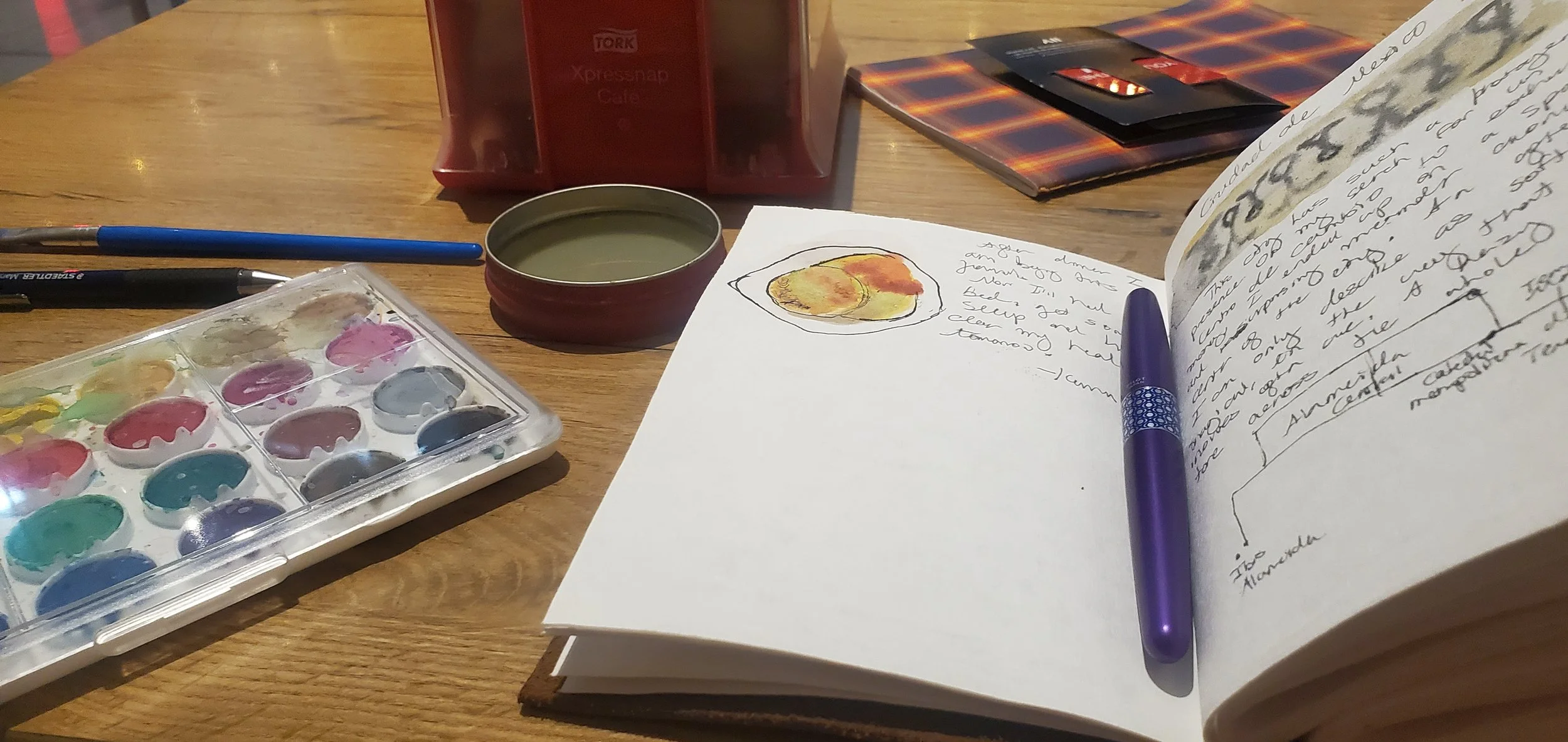
When I left my job last year, one of the things I did was travel internationally as a tourist for the first time in my life. I purposefully left my laptop behind. took a leatherbound notebook and journaled every day, adding shaky but colorful watercolor sketches along the way. My challenge was to write uncensored, about sensory details, little interactions, and rambling trains of thought.
A throughline emerged. Not surprisingly, I often wrote about how my identity politics interacted with new surrounding and cultural contexts. Choosing to write daily kept me on the lookout for small moments of connection with people, with objects, and places. I found a spark in the most mundane of exchanges and I looked forward to filling in the details when I got back in the evening.
When I returned home, the essays wrote themselves, linking together highlights and takeaways that had percolated at a subconscious level beyond deadline and publishing pressure.
Writing without expectation from others, and most of all from myself, was freeing. Having turned something I loved into a job, I had also lost the joy and motivation behind writing.
With the rigid rules of production removed from the expectation of my work, here are the four key “unlearnings” that rekindled my connection to narrative, even if they directly challenge the rules of
Decentering audience and organizing around intrinsic curiosity: removing an obsession with audience carved the quietness I needed to listen to what I find compelling in making choices to interact with the world. This allowed me to look for often quieter, subtler plot points to anchor what I wanted to write about. Out of those choices emerged a pattern that helped me recognize my natural strength and style as it relates to narrative form.
Focusing less on source attribution and more on witnessing observation. This shift asked me to do two things; one, face my fear of being seen as too navel gazey, and two write from what I saw and felt in the moment and veer away from trying to make overly factual claims of “truth” or “objectivity.” In other words, I embraced bias so that I was no longer fighting to prove some kind of neutral stance. And god isn’t that freeing.
Redefining knowledge to be more than words and intellectual reason. Literary writers talk about this often, but it felt beyond my grasp in the journalistic cannon because the form and function of reporting goes to research, sources, and fact checking. Somatic knowledge, in my experience, meant translating the knowing of the body, of sensations, of atmospheres, energy and ambiences and all the non-verbal ways we gain information form the world around us. Reporting focuses – as it should – on fact, on corroboration, on attributions from sources, on just enough sensory detail to create “color’ in a scene, but not too much to become subjective. I learned that my body knows things, and it is okay to embrace that as a legitimate epistemology.
Turning down the volume on external editorial input. This one perhaps is hardest, because the crux of it permeates everything we do in our modern lives. We do everything with a slight question mark beckoning for someone else to give us the thumbs up of approval whether online or in our own social and professional circles. I had learned not to trust my own writing unless I’ve had an editor sign off, someone else to say “this idea is worthy of being read” … which again takes us back to the trap of the audience. Unlearning this meant I had to become my own editor, my own cheerleader and my own critique. In doing that, what you begin to build is self-trust in your raw work, your judgment, and the risks you take. I’m still figuring this one out (I’ve already cringed several times while drafting this, for example).
The culmination of these unlearnings unfolded when I took my travel journal entries and compiled them into a messy, but loving, draft of essays. When I printed out the draft just a few days short of the New Year, I felt the giddy weight of those 116 pages bound in my hands. I never thought I would write anything of manuscript length.
I knew what I held in my hands was imperfect. But, it was 100% a labor of rebuilding trust in my creative judgment and my way of interacting with the world. Moreso, it was a mirror of what I am capable of in the raw, the baseline upon which collaboration could create something stronger and cleaner. This trust is not about believing in talent or success, but about re-grounding in the creative integrity that my professional environment had dulled. I left my job wondering what the point was in anything I did. Now, I realized, there being a point wasn’t really it at all.
I’ve tentatively titled the manuscript “Micromoments” and it is essentially a stripped down version of myself. And you know what? I quite like that barebones, unpolished, version of my work even if it admittedly feels too self-reflective at times. Something need not be perfect or even palatable for you to like it.
The biggest little win of 2025 was the quiet work of this ragtag first draft. It is a reclamation of my voice as a writer which was only possible because I stepped away from my job. In the structure of a media institution and the hustle culture required to make it in media, I never had the time, the mental bandwidth, and the willingness to bet on myself while I was there.
Within the practice of our respective media fields, it is important to find a space where we can test, and unlearn the very rules that give us glue in the professional systems of our work. I think we need to in order to connect back to why we come to any form of narrative work to begin with.
Stripped of the narrow container of what constitutes a “story” and it’s “angle,” we can actually have to space to reconnect with the drive and internal reasons of why we build stories out of the world. I recall the umber of times someone has said in an editorial environment “that isn’t an interesting story” and I’ve had to bite my tongue to argue otherwise.
That kind of thinking hinders us from finding stories in the everyday, the little moments that are worth noting even if they don’t follow an arc of intrigue and resolution. Our minds and hearts know what we want to write about and we need to be able to trust those inner compasses to do this work with integrity. Rather than audience reception, I think following that innate curiosity is itself the reward.
